

A good job should still be the best social policy
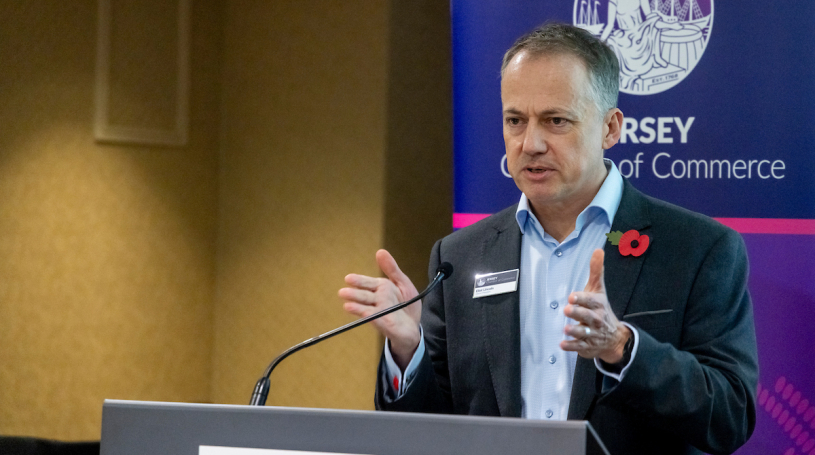
A good job should still be the best social policy
Good afternoon everyone, and welcome.
It is a great pleasure to welcome our guest speaker today, Senator Elaine Millar, Minister for Social Security, who will be speaking after lunch.
Given the Minister’s portfolio, I thought I should probably talk about social security. But don't worry, I'm not going to attempt to explain the Social Security system to you. We have the actual Minister here, and five minutes isn't nearly long enough.
Instead, I want to start with a fairly simple question: what actually gives someone economic security?
For most of us, I think the answer starts with a good job. A job that pays fairly, where somebody feels valued, where they can learn and progress and, perhaps most importantly, which gives them confidence that they can build a future here in Jersey.
That may sound obvious, but I sometimes wonder whether, in all our debates about benefits, minimum wages, pensions, taxation and the cost of living, we lose sight of something quite fundamental.
Businesses employ people.
Successful businesses create jobs. They train people, develop careers, support families and give someone the opportunity to progress from their first job to managing a team, running a business or perhaps starting their own.
And let me make this quite clear, from a Chamber perspective - your employees, your staff, your team, they are important - they are the crucial ingredient in the success of any business… their welfare and wellbeing is important, and they are and should always be a priority.
And the more successful and productive those businesses become, the greater their capacity to invest, grow and, importantly, pay people better.
The latest labour market figures give us some grounds for optimism. Jersey had 65,790 jobs in June, the highest number recorded, with record totals in both the private and public sectors and 440 more jobs than a year earlier. That is welcome, but the headline needs context. A record number of jobs does not, by itself, tell us whether our economy is becoming more productive, whether those jobs offer genuine progression, or whether businesses have the confidence to keep investing.
From a Chamber perspective, the headline masks some significant differences. Private education, health and other services gained 440 jobs, and financial and legal activities gained 80. However, wholesale and retail lost 130 jobs, while hotels, restaurants and bars lost 50. The latter should be rightfully concerning for all of us, not least of those Chamber members associated with our retail and hospitality sectors.
The challenge is not simply to create more jobs, but to create good jobs and ensure that growth in employment translates into improved living standards.
That is one reason you hear Chamber talking so much about productivity. I admit, productivity isn't the most exciting word to introduce at lunchtime. I suspect very few people woke up this morning thinking,“I really hope Eliot talks about productivity before lunch.”
But it matters, because productivity is ultimately about doing more with the resources we have and creating the prosperity that allows wages and living standards to improve sustainably.
We have said before that if Jersey is serious about tackling the cost of living, it also has to understand the cost of doing business. The two aren't separate conversations. Rising business costs ultimately find their way somewhere, whether through prices, wages, investment decisions, profitability or employment opportunities.
But I don't want this to become another speech about what Chamber thinks Government should do. I have made a few of those recently. Members will know that Chamber has also had plenty to say about the Budget and matters leading up to the recent announcement on minimum wage . I remain concerned that we need greater ambition around economic growth, competitiveness and productivity, but you will be relieved to hear that I am not going to rehearse the whole argument again today.
Because businesses have responsibilities too.
We need to invest in people, train them and create workplaces where people want to stay and progress. We need to embrace technology rather than fear it, and we need to create opportunities for the next generation of Islanders.
That is very much where Chamber is putting its energy.
Our Employment and Skills Committee continues to bring employers together and make sure that the voice we take to policymakers reflects the practical experience of the businesses actually employing people in Jersey.
Our Digital Advantage Committee’s work is increasingly looking at how technology, data and AI can help businesses across every sector become more productive, competitive and resilient.
And I am particularly excited about our new Future Economy Committee, led by Gaelle Deschamps. The idea behind it is straightforward: to look beyond the economy we have today towards the industries, entrepreneurs and opportunities that could shape Jersey's economy tomorrow. It should also give a voice within Chamber to emerging parts of our economy that have not always fitted neatly into our traditional structures.
But prosperity isn't only about the commercial economy.
We are also working towards establishing a new Voluntary and Community Committee, building on the tremendous work that Jim Hopley has done over many years to strengthen the relationship between Chamber, charities and the voluntary and community sector.
I think that matters. Because when we talk about the future of Jersey, business, government and our voluntary and community organisations aren't three separate worlds. They rely upon each other. A successful Island needs all three to thrive.
And that is really the direction I want Chamber to continue taking. We should challenge when challenge is needed, of course. That's part of our job. But Chamber shouldn't simply be an organisation that sits on the sidelines pointing out what is wrong. We should be one of the places where people come together to work out what we can do about it.
And that is why, despite some of the challenges we face, I remain enormously optimistic about Jersey.
Our size is frequently described as a disadvantage. Sometimes it is. But it should also be one of our greatest advantages.
We have a sophisticated economy, excellent businesses and a remarkable concentration of experience and expertise in an Island of just over 100,000 people. Our business leaders, politicians, educators and community organisations often know each other personally.
There are genuinely very few places where collaboration ought to be easier.
If technology helps a small Jersey company become more productive, it can compete more effectively. If it competes, it can grow. If it grows, it can invest more in its people.
And that is where productivity stops being an economic statistic. It becomes someone's pay rise, somebody's promotion, an apprenticeship, a new job or perhaps the difference between somebody deciding they can build their future in Jersey and deciding they need to look elsewhere.
That, to me, is prosperity with a purpose.
I'm optimistic not because I think everything is fine. It clearly isn't. Nor because I think Government has all the answers. I am fairly certain Government doesn't think it has all the answers either.
I'm optimistic because very few of Jersey's problems are actually beyond our ability to solve.
Government has a responsibility to create the conditions in which enterprise can succeed. Businesses have a responsibility to use those conditions to invest, innovate, train people and create opportunities. And our community and voluntary organisations
provide much of the social fabric which makes Jersey somewhere people actually want to live.
Ultimately, a strong economy isn't the objective. What that strong economy gives people is the objective.
A decent standard of living. The opportunity to progress. The confidence to raise a family here. And the security that comes from knowing your skills are valued and your work gives you a future.
Which brings me neatly back to where I started.
Perhaps one of the most powerful social policies we have isn't really a social policy at all.
It is a successful business giving someone a good job.